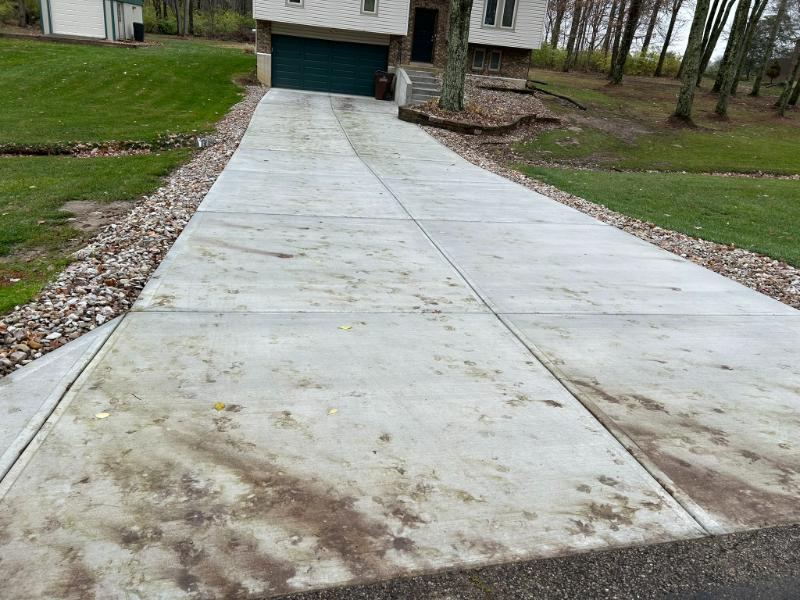
Your driveway is the first thing people see when they pull up to your home. It's also the surface that takes the worst beating in Ohio. Freeze-thaw winters crack and lift it. Road salt eats at it from December through March. Spring pollen coats it yellow, humid summers grow algae in the shade, and fall buries it under wet, staining leaves. Most homeowners don't notice the slow slide until the concrete looks a decade older than it is.
The hard part is knowing when a quick rinse with the garden hose isn't enough anymore. By the time grime is obvious from the street, it has usually worked its way into the pores of the concrete where a hose can't reach. Here are seven signs it's time to bring in professional driveway cleaning — and why each one matters more in our climate than almost anywhere else.
1. Green or Black Patches Are Spreading in the Shade
Walk to the side of your driveway that sits under a tree or along the north edge of the house. If you see green film or dark blotches, that's algae and mildew. Ohio's humid summers and damp, leaf-covered falls are a greenhouse for both. They love shade, moisture, and a surface that never fully dries out.
This isn't just a cosmetic problem. Algae holds water against the concrete, and that trapped moisture is exactly what turns a small surface crack into a big one once the first hard freeze hits. It's also slick. A green patch near your garage or front steps becomes a fall hazard the moment it rains or frosts over.
A garden hose pushes algae around. It doesn't kill it, so it's back within weeks. A proper soft-wash treatment uses a surface-safe cleaning solution that kills the growth at the root, which is why the surface stays clean for far longer. We treat the biology, not just the color.
2. Rust, Oil, or Tire Marks That Won't Rinse Off
Some stains are surface dirt. Others have soaked in. If you've scrubbed an oil spot or a rust streak and it's still there, it has bonded with the pores of the concrete, and no amount of scrubbing pressure alone will lift it.
Common driveway stains in Ohio homes include:
- Engine oil and transmission fluid drips under where you park
- Rust bleeding from a planter, a basketball hoop base, or metal furniture
- Hot-tire pickup, where dark tire marks transfer onto the concrete
- Battery acid or fertilizer spills that etch the surface
These need the right cleaning solution and dwell time, not just force. In fact, cranking up the pressure on a stubborn oil stain often etches the concrete without removing the stain — you end up with a clean-looking scar. Targeted oil stain removal pulls the contaminant up out of the pores instead of grinding the surface down. It's a different process than general washing, and it's worth doing right the first time.
3. A Thick White Crust or Chalky Film (Hello, Road Salt)
If your driveway looks like it's wearing a faint white powder, especially in late winter and early spring, you're looking at a mix of efflorescence and road salt residue. Ohio roads get salted heavily, and every time you drive home, your tires carry that salt onto your concrete.
Salt is one of the most destructive things a driveway faces here. It works into the surface, draws in moisture, and accelerates the freeze-thaw cycle that flakes and spalls concrete apart. Left alone, you'll see the top layer start to pit and crumble — and at that point, you're talking about repair, not cleaning.
A spring wash that flushes salt and de-icer residue out of the surface is one of the best maintenance habits an Ohio homeowner can build. It's cheap insurance against a problem that gets very expensive once the concrete starts breaking down.
4. Your Driveway Is Noticeably Darker Than It Used to Be
This one sneaks up on people. Grime builds so gradually that you stop seeing it. Then a neighbor gets their driveway cleaned, or you wash one section to test something, and the contrast is shocking. The 'clean' part you remember was actually years of dirt you'd gotten used to.
Pollen is a big driver of this in our area. Spring in southwest Ohio coats everything in a yellow-green film, and on concrete it bonds with dust and exhaust into a dull gray-brown layer. Summer humidity bakes it in. Fall leaves leave behind tannin stains — those reddish-brown ghost marks shaped like the leaves that sat there too long.
If you can't remember the last time your driveway looked genuinely bright, that's your answer. Professional concrete cleaning uses even, controlled cleaning across the whole slab, so you don't end up with the streaky, zebra-striped look that a pressure-washer wand leaves in untrained hands.
5. Streaks, Stripes, or 'Zebra Marks' From a Past DIY Job
Plenty of homeowners rent a pressure washer, give it a weekend, and end up with a driveway that looks worse than when they started. Those alternating clean-and-dirty stripes happen when the spray hits the surface unevenly — too close in some passes, too far in others. The wand also leaves swirl marks and 'wand burn' where the tip gouged the concrete.
If your driveway already has these marks, it actually needs a professional more than a clean driveway does. The fix is surface cleaning with a flat-surface cleaner that holds a consistent distance and pressure across the entire slab, blending out the stripes instead of adding new ones.
There's real skill in matching pressure and technique to the age and condition of the concrete. A newer slab and a 30-year-old driveway with hairline cracks should not be cleaned the same way. That judgment is most of what you're paying for, and it's exactly what keeps a cleaning from turning into damage.
6. Weeds and Moss Pushing Up Through the Cracks and Joints
Look at the expansion joints and any cracks running across your driveway. If grass, weeds, or spongy green moss is growing out of them, water is sitting in those gaps — and in Ohio, sitting water plus winter equals widening cracks.
Here's the chain reaction: organic growth holds moisture in the joint, that moisture freezes and expands, the crack opens a little wider, more debris collects, and more water gets in. Each winter makes it worse. Clearing the growth and flushing the joints stops the cycle before it pries your slab apart.
A thorough cleaning gets into those joints and removes the organic matter a broom can't touch. It also makes it obvious which cracks are just cosmetic and which ones are starting to move — useful to know before you decide whether to seal the driveway.
7. You're Selling, Hosting, or Just Tired of the Curb Appeal Hit
Sometimes the sign isn't damage. It's the look. A dingy driveway drags down the whole front of an otherwise well-kept home. If you're listing the house, hosting a graduation party, or you simply pulled in one evening and thought 'when did that get so bad,' that's a perfectly good reason to clean it.
For home sellers especially, a clean driveway and walkway is one of the highest-return, lowest-cost improvements you can make before photos. Buyers form an impression in the first few seconds, and bright concrete reads as 'well maintained' across the entire property.
This is also the easiest sign to act on, because there's no urgency clouding the decision. You're not waiting for a problem to force your hand — you're just choosing to have your home look the way you want it to. We serve homeowners up and down the I-75 corridor between Dayton and Cincinnati, including Springboro and Mason, and statewide across Ohio.
Get a Straight Answer Before It Costs You More
The honest truth is that most of these problems are cheaper to prevent than to repair. Algae, salt, and weed-filled joints all do their worst damage during Ohio's freeze-thaw months, so the best time to address them is before winter, not after the concrete starts spalling. A clean, well-maintained driveway routinely lasts years longer than a neglected one.
Redhead Pressure Cleaning LLC is licensed and insured, and we use surface-safe soft-wash methods matched to the age and condition of your concrete — no guesswork, no wand burn. We treat your home as our own, and we're proud of our 5.0-star rating across 55 Google reviews. If you recognized your driveway in even one of these seven signs, we're glad to take a look and tell you honestly what it needs.
Call or text us at (351) 242-0666 for a free estimate on driveway pressure washing anywhere in our Ohio service area. No pressure, just a clear answer.